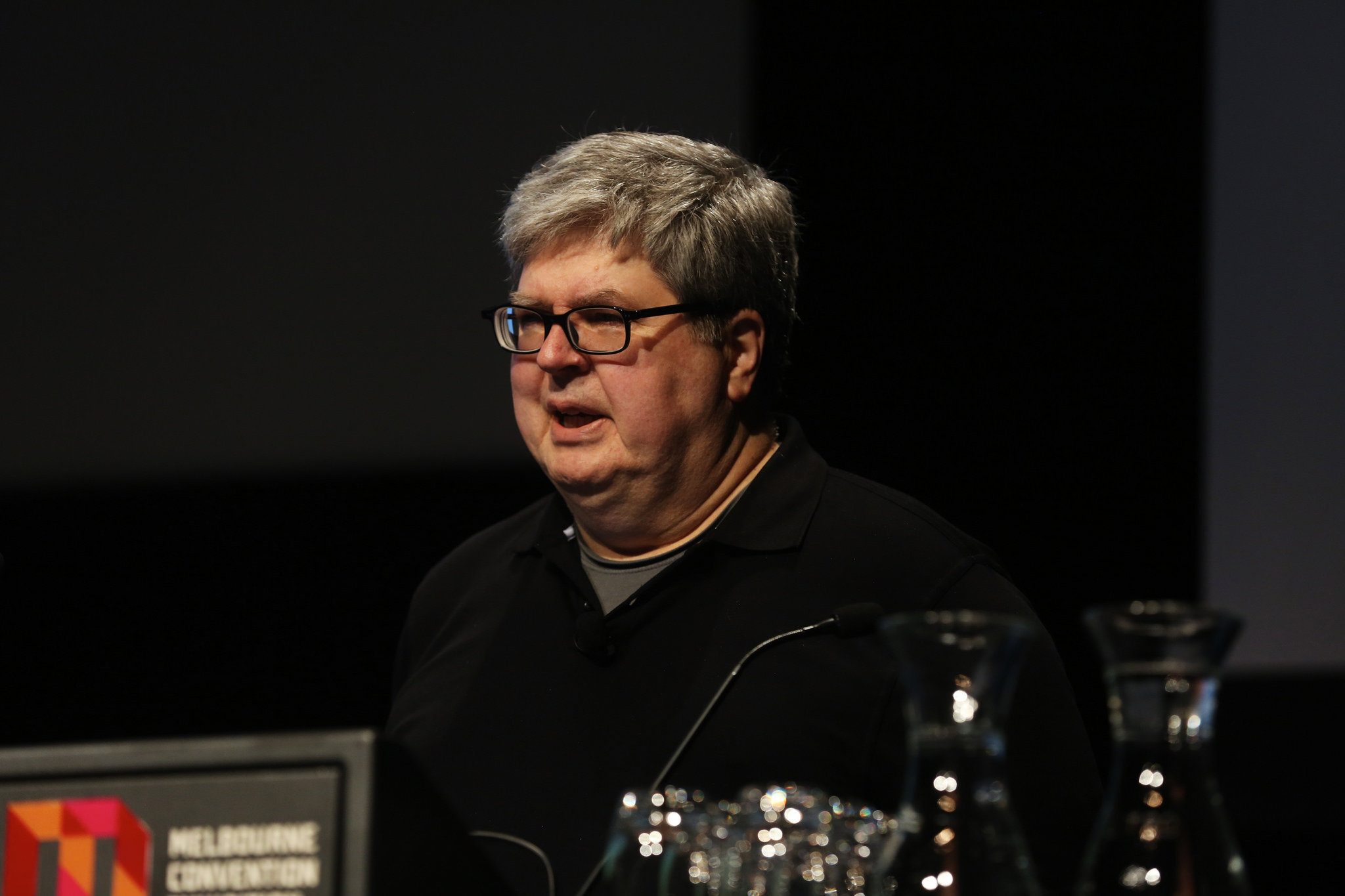
Tony, Craig and Renee are at Agile Australia and catch up with Steve Krug and talk usability and along the way try to figure out whether Tony is lean, agile or just old…
Renee, Tony and Craig are at Agile Australia and sit down with Adrian Fittolani from Envato and discuss program management and monte carlo simulations. Renee also makes an estimate that is super accurate!
utilise bottom up program management at Envato, they have 4 main themes as a company and use self organising themes to meet those themes
had to evolve from co-located teams as could not find local resources, they now have any person working in any team wherever they are and make that work, they try to keep teams in close timezones and use asynchronous communication tools, have a policy to work anywhere and additionally a policy to travel and work from anywhere in the world for 3 months
the teams responsibility is to radiate program status, currently using a short document with a timeline view
launch wall for important items kicking off in the next 2 weeks – helps eliminate surprises
project is where more than one team is involved, form a circle around the project (like holacracy)
monte carlo simulation- replace subjective estimation techniques that most projects use and rather use a lean approach of takt time to model a project teams delivery
takt time – the drumbeat, the time it takes for a process to deliver to another process (e.g. how often a car comes off the production line or how often a story is delivered)
value of monte carlo is that it is non-subjective as well as allowing you to decide on the spread of risk you are prepared to take
Craig and Tony are roaming the conference floor again at Agile Australia in Melbourne talking to more interesting people in the Australian Agile community:
Renee has been busy being sick (and Tony and Craig are sick of being busy) and thus it has been a long time between cough syrup for our Revolutionists…
The Scrum Guide was updated in July 2016 to add some value(s)
Craig and Tony are at YOW! Conference and are privileged to spend some time with Don Reinertsen, who is considered one of the leading thinkers in the field of lean product development and author of numerous books including “Principles of Product Development Flow”
Taiichi Ohno, the father of the Toyota Production System, hated math and thus preferred to sit on the factory floor and tweak processes, hence it was not a theory driven approach but rather empirically driven
Need to understand why things work so you can transfer it to other domains, a big shortcoming in lean manufacturing is that they don’t have much of a mathematical view on what they are doing
You can use magic in manufacturing because it is highly repetitive
People understand iterations are good to do but do not understand why
“Antifragility is beyond resilience or robustness. The resilient resists shocks and stays the same; the antifragile gets better” (Nassim Nicholas Taleb)
Agile software people are doing a better job at lean product development because software people have already crossed the chasm of inspect and adapt
There are many sources of variability other than just people, such as the Internet and the fact we are constantly doing things people have not done before
To get management to listen about cost of delay you need to benchmark what you are doing today
Agile eliminated the economic gene, hence it works well bottom-up
Easiest way to introduce quantitive based decision making is to find a project manager who wants an economic model (as they will be fighting for resources and the guy with the numbers will end up winning because they can communicate their needs)
Lifecycle pretax profit is far more useful than ROI
Start with Chapter 1 in the book – describes what is wrong with what we are doing today, then look for the tree that is ready to be pushed over in your organisation as there is no one way of approaching this
The low hanging fruit is: visual control boards, economic model, batch size reduction and WIP constraints
The first knob to turn is batch size reduction
It is 175 principles in small little batches that add value, it is not the ten commandments!
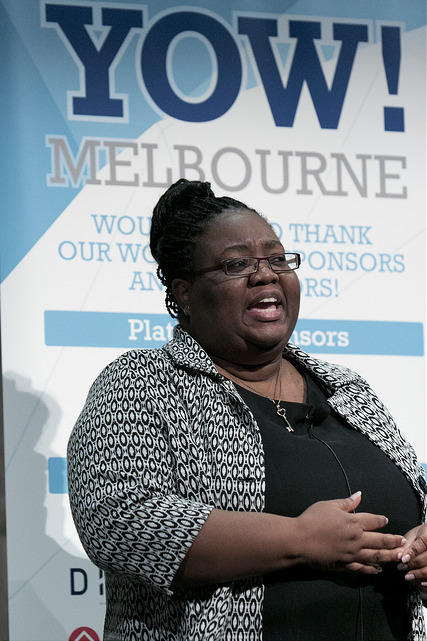
Craig and Tony sit down for a conversation at YOW! Conference with Betty Enyonam Kumahor (stands for good for me, on the way there) who is a technology leader in Africa:
Tony and Enyo are mutual members of the Alistair Cockburn fan club
Software engineering uptake in Africa is very low, need more technologists because it is is not an industry it is an enabler
Lots of diversity challenges in Africa – lees than 1% of the South African IT industry is women, but also diversity in languages, education and belief systems
Diversity is a multi-pronged issue, need to be patient but not complacent to move the needle forward, give girls the confidence to be competent and to push the boundaries
Frugal innovation in Africa – building technology in a space of constraints such as inadequate power, everything happens by mobile feature phones, needs to be built fast and cheap
Agile in Africa – need to make communities more aware of Agile practices, share what developed world has learnt but also what needs to adjust for the context of the continent
Growth of techpreneurs, expensive to do business in Africa, focus on local market rather than off-shoring to Europe
Andela program – train to be a software engineer, become a fellow and work for offshore clients
Successful conversions from tech hubs to startups is below 5%
Biggest issue is lack of access to expertise in Agile / Lean practices as well as lack of people to adapt it for the continent
Agile as a word has become meaningless, don’t follow the off-the-shelf processes, apply small corrections to move forward
Story of Stone Soup is like Agile consultancies, the hard work is done by the companies
Scrum is a good starting point due to its simplicity
Raccoon is a noun, so not a good replacement name for Agile, because you can buy a pound of it
1,000 working on one thing can never be Agile, you have to make enterprises agile before you can run an agile project
The values in the Agile Manifesto hold up well, would have been nice to have had more diversity, had no expectation they were going to create something so significant
The Agile Manifesto was a reaction to the problems in development at the time, maybe something new is required, it would be a tragic mistake to create Agile Manifesto 2.0, we need to ask what is more relevant today to express our frustrations
Agile is a fundamental way of thinking about doing stuff, that’s why it’s important to understand why we are doing it
The Pragmatic Bookshelf was accidental by saying the dreaded words “how hard could this be”, the strength is knowing nothing about publishing, everything was automated unlike traditional publishers and still runs with 2 main employees, now storyboard books like a movie as the reader is on a learning journey
Ruby has a future, but it needs to distinguish itself as a fantastic general purpose programming language, the community is still very friendly and innovative
The emphasis and dogma around testing is off-putting, the amount of effort around many tests are not moving people forward
Craig and Tony are once again roaming the lunch hall at YOW! 2015 in Brisbane, where they catch up with a number of people including:
Dave Thomas – founder of YOW! Conference discusses the success of YOW! Conference in Australia and how he didn’t go to Snowbird for the signing of the Agile Manifesto
Nigel Rausch – organiser of the Brisbane Ruby meetup tells us what’s new in the Ruby community and comments on the number of talks related to microservices
 Tony, Craig and Renee are at Agile Australia and catch up with Steve Krug and talk usability and along the way try to figure out whether Tony is lean, agile or just old…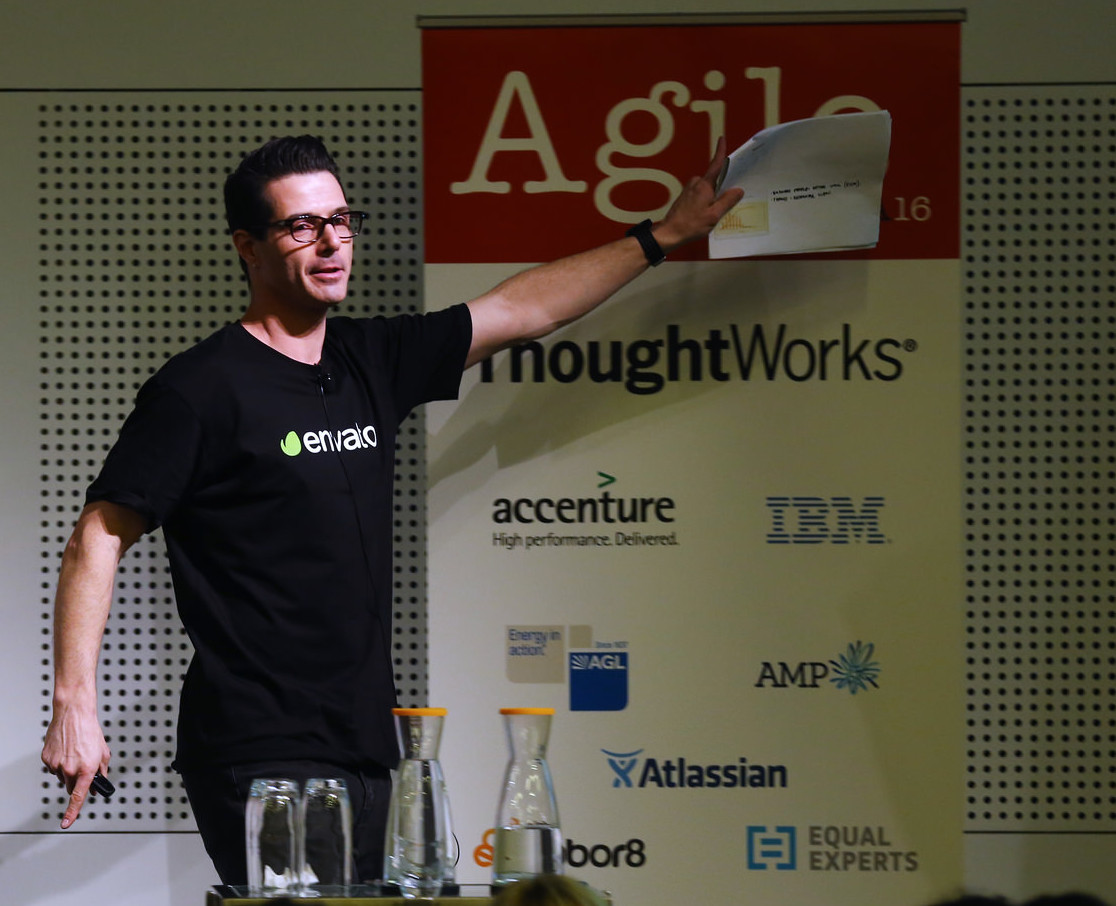



 The Agile Revolution Podcast