Within this podcast we learn what exactly a Lean Start-up is and how it isn’t just for new entrepreneurs.
In addition to the Lean Start-up presentation Josh also did a fantastic presentation on the Limited Red Society which focuses on using metrics and visualisation of these to behaviourally change a developer so that their tests pass sooner and more often with less compilation errors.
Other than being an early pioneer in eXtreme Programming, he is also the author of the best-selling Refactoring to Patterns book and provides Agile training from an amazing technical depth of experience.
Not focussing on the three questions (What I did yesterday, What I plan on doing today and roadblocks)
No consistency in the way it is run
Too big
Directed to PM
Directed to IM/Scrum Master
Conversations are not off-lined
Conversations are off-lined too quickly
Risks to delivery not understood
No one volunteers to help
Too short/not meaniful enough
Too boring/monotonous
Run like a progress report
Functionally unrelated teams doing the standup together
Too many people talking at once or no stick
Not talking about actions for retrospectives
People don’t want to be there/been told to turn up
and we missed (bad smells for story walls not included)
Customer never/rarely turns up
PM unpredictably turns up and then asks questions that they could have known if they turned up to previous sessions
How to run a Bad Smell Practice Bingo game yourself:
Get your team into a room. Each person needs a single piece of paper and a pen.
Choose a practice to focus on.
Give everyone 3-4 minutes to brainstorm bad smells associated with this practice.
Randomly choose a person to go first, they read out one item on their list.
If you have the item on your list give it a tick.
Go around clockwise from the first person, each person reads out one of the items on their list. Continue to tick off items on your own list if you have it as it is read out.
If you have 10 ticks yell Bingo!
Profit.
Quotes:
You cannot physically be in two places at once, so why expect to be mentally in two places at once. Limit Work In Progress
With Tony on assignment on an island, Craig and Renee talk about motivation, Renee makes a ballsy prediction about fun and we talk about dead walls, tools for walls and everything in between:
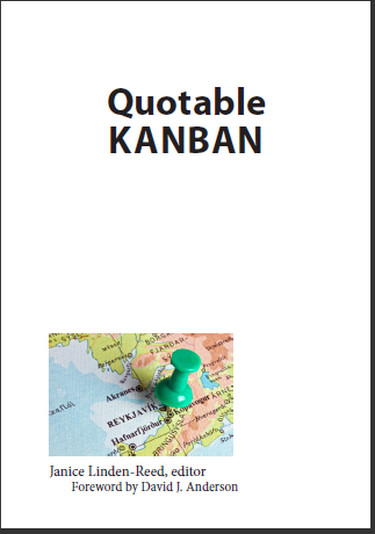
Craig, Tony and Renee talk about Lean Startups, Tony’s Agile training in India and great places to work, discuss Quotable Kanban and solve a listener problem, all in 50 minutes!
We have a Product Mgr who’s supportive of Agile in theory, but wont do the work we need him to do. How do we manage that? eg not being available for to discuss stories (often away) & the highest priority work is the customer who screams loudest… rather than product progression, we do a lot of tweaks & minor bug fixes. Yes we do showcases, after each 2 wk sprint. Alternatively, is that a problem, or are we as a team expecting too much? (just to turn it around!) 🙂 – Phil Kan
Quotes:
“”I’m going to the restroom. Do you need anything from there?” (but in my mind I was thinking I was headed to the kitchen!) #CEOQuoteOfTheDay @sumaya”
Trying to improve quality by increasing the amount of testing is like trying to lose weight by weighing yourself more often (@rowanb) #yam
And so much time was spent on referring to this book or that book that we just had to link what books we unwittingly covered in what we like to call Tony’s Oprah Winfrey Bookclub!
Chasing the Rabbit or now known as The High Velocity Edge by Steven Spears; recommended by Tony as a great Lean book.
Agile Retrospectives – Making Good Teams Great by Esther Derby and Diana Larson; there might be a reason why this wasn’t discussed, but Renee did read it recently; it was okay but potentially an overrated book.
Quotes:
“Some tribes are stuck. They embrace the status quo and drown out any tribe member who dares to question authority and the accepted order.” – Seth Godin, Tribes
“Agile projects are like guided missiles, the customer discovers what they want, the developers discover how to build it and the things change along the way.” – Henrik Kniberg
The best agile teams leave their job titles at the door. Instead of "I am a tester", let's say "I am a team member with testing skills".
 Craig and Renee wrap up the YOW! Developer Conference and discuss the geek aspects of it and then how some of the conference related to Agile.






 The Agile Revolution Podcast
